
Which Part of Bali is Right for Your Retreat? A Region-by-Region Guide
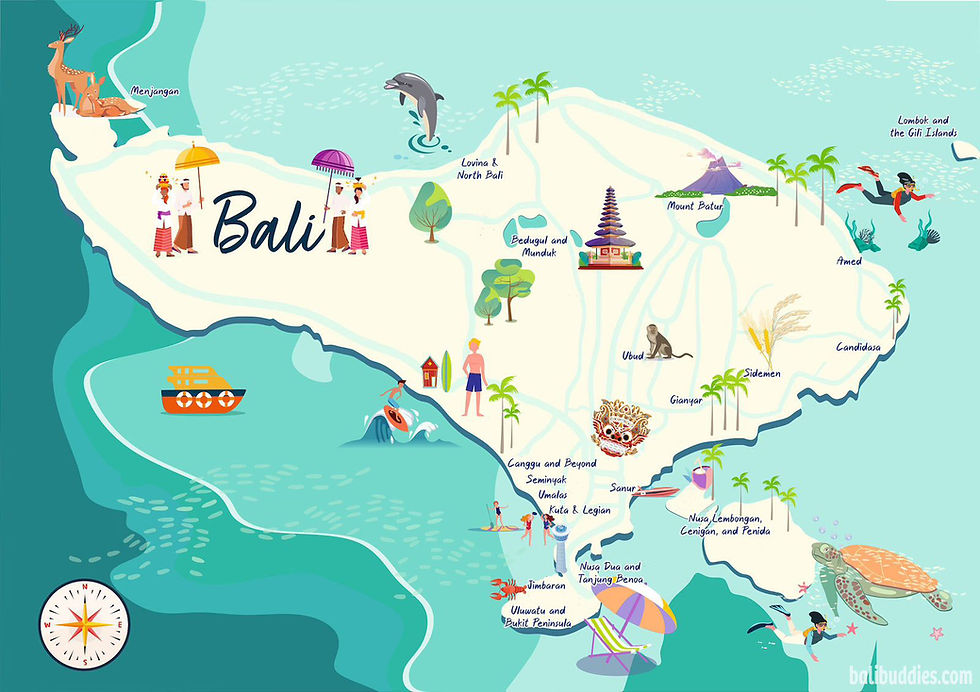
Bali is a small island — roughly 5,700 square kilometres — but the experience of hosting a retreat in Ubud is fundamentally different from hosting one on the coast, or in the mountains of the north. Where you choose to host shapes everything: the mood, the activities, the pace, and the kind of guest experience you're able to create.
This guide breaks down Bali's five main retreat regions — Ubud, East Bali, North Bali, South Bali, and West Bali — so you can make the right choice for your retreat before you start looking at venues.
Ubud — The Cultural and Spiritual Heart
Best for: Yoga and meditation retreats, spiritual and healing programs, mindfulness, cultural immersion, breathwork, somatic work.
Ubud is the most established retreat destination in Bali, and for good reason. Sitting at around 700 metres above sea level, the air is cooler than the coast, the pace is slower, and the surrounding rice terraces and jungle create a natural stillness that guests consistently describe as different from anywhere else on the island.
For retreat leaders, Ubud offers the widest range of supporting infrastructure: experienced local healers, yoga teachers, ceremony guides, cooking instructors, and wellness practitioners are concentrated here in a way that simply doesn't exist in other regions. The food scene is strong, with an outstanding plant-based and organic culture that naturally supports wellness-focused programs.
Practical considerations:
Approximately 90 minutes from Ngurah Rai Airport (DPS)
Most retreat properties sit in the surrounding villages of Tegallalang, Payangan, and Mas — within 20–30 minutes of central Ubud
The widest variety of venue options at all price points, from boutique guesthouses to private luxury villas
Honest caveat: Central Ubud can feel busy, particularly around the main market area and Monkey Forest Road. Retreats that want complete seclusion should look at properties in the outer villages rather than central Ubud itself.
Soul Bliss Journeys works extensively in and around Ubud — browse our Ubud-area venues here.
East Bali — Dramatic Landscapes and Deep Stillness
Best for: Retreat leaders who want seclusion, nature immersion, volcanic scenery, and a quieter, slower-paced environment.
East Bali sits in the shadow of Mount Agung, Bali's most sacred volcano, and the landscape reflects that energy: dramatic, raw, and quieter than almost anywhere else on the island. The region covers areas including Sidemen, Amed, and Candidasa — each with a distinct character, but sharing a common sense of remove from the tourist corridors of the south.
Sidemen, in particular, has become a quiet favourite for retreat leaders who want rice terrace scenery without the busyness of Ubud. The valley is stunning, the pace is slow, and the sense of being genuinely away from it all is real.
Amed, on the northeastern coast, offers black sand beaches and exceptional diving and snorkelling, making it a natural fit for retreats that want to combine wellness with water-based experiences.
Practical considerations:
Sidemen is approximately 2 hours from the airport
Amed is 2.5–3 hours from the airport — factor this into your guest arrival logistics
Fewer venue options than Ubud, but those that exist tend to be distinctive and well-suited to smaller, more intimate groups
Supporting activity infrastructure (local guides, healers, practitioners) is thinner than Ubud — more planning lead time required
Best fit for: Retreat leaders whose program benefits from immersion in nature and genuine seclusion, and whose guests understand and value remoteness.
North Bali — Mountains, Waterfalls, and Off-the-Beaten-Path
Best for: Nature-immersion retreats, adventure and wellness combinations, retreat leaders who want to offer guests something genuinely different from the main tourist trail.
North Bali — centred around Lovina and the highlands leading to Munduk and Bedugul — is the least visited part of the island by international tourists, which is precisely what makes it appealing for retreat leaders looking to create a more original experience.
The landscape here is lush and mountainous, with waterfalls, crater lakes, volcanic highlands, and a pace of life that feels more like rural Bali than the tourist south. The north coast has calm, flat water (unlike the surfing beaches of the south), making it suitable for swimming and water-based activities without the crowds.
Practical considerations:
Approximately 2.5–3 hours from the airport — the longest drive of any region on this list
Venue options are more limited and tend to skew toward smaller boutique properties rather than large private villas
The relative remoteness is both the appeal and the challenge — it requires more logistical planning around transport and local supplier access
Best fit for: Retreat leaders whose ideal guest is genuinely adventurous and values authenticity over convenience, and whose program is built around nature, landscape, and getting off the tourist path.
South Bali — Coastline, Energy, and Easy Access
Best for: Wellness and surf combinations, corporate retreats, groups that want beach proximity, retreats where easy airport access matters.
South Bali covers a range of distinct sub-areas — from the upscale villas and restaurants of Seminyak and Canggu to the clifftop drama of Uluwatu and the calmer, family-friendly beaches of Sanur and Nusa Dua. The energy here is more outward-facing than Ubud or the east: it's a place of movement, activity, and visual spectacle rather than inward stillness.
For retreat leaders, South Bali's main advantages are practical: it's the closest region to the airport (20–45 minutes depending on exact location), it has the widest range of restaurant and nightlife options for guests who want downtime flexibility, and the infrastructure for surf, water sports, and coastal activities is unmatched anywhere else on the island.
Practical considerations:
Closest to the airport — straightforward logistics for arrival and departure
Uluwatu, in particular, offers dramatic clifftop settings that photograph exceptionally well for retreat marketing
Canggu has a strong digital nomad and wellness community, with co-working spaces, yoga studios, and health food options in abundance
Traffic in and around the Seminyak/Canggu corridor can be significant — factor this into your daily logistics
Best fit for: Retreat leaders running programs that intentionally combine wellness with surf, adventure, or a livelier social atmosphere, and those whose guests prioritise beach access and convenience.
West Bali — Remote, Undiscovered, and Deeply Private
Best for: Small, intimate retreats that prioritise absolute privacy and a true sense of escape.
West Bali is the island's least-visited region — and for retreat leaders who want to offer their guests something genuinely different, that's a significant advantage. The West Bali National Park covers much of the western tip of the island, and the areas outside the park are characterised by quiet villages, long stretches of uncrowded black sand beach, and a pace of life that feels entirely removed from the tourist economy of the south.
Retreat venues in West Bali tend to be singular, distinctive properties — the kind that exist specifically because their owners wanted something different from what Ubud or Seminyak offers.
Practical considerations:
1.5–2 hours from the airport, but in the opposite direction from most of Bali's retreat infrastructure
Very limited venue options — your choices here are narrower than in any other region
Supporting activity infrastructure (local guides, wellness practitioners, specialised suppliers) requires more planning than Ubud or South Bali
The remoteness is the product — if your retreat program is built around stillness, nature, and genuine disconnection, this is where that experience is most authentic
Best fit for: Small-group retreats (typically under 12 guests) where the retreat leader specifically wants privacy, exclusivity, and a setting that feels genuinely off the map.
How to Choose
The right region comes down to three questions:
What kind of experience are you creating for your guests? Stillness and inward work → Ubud or East Bali. Nature and adventure → North or West Bali. Energy and access → South Bali.
What does your guest profile value? A group of first-time international travellers who want easy logistics and familiar amenities will have a different experience in remote East Bali than an experienced wellness community actively seeking seclusion.
What does your program actually require? If your itinerary involves daily sessions with local healers, traditional ceremonies, and a wide variety of supporting activities, Ubud gives you the most to work with. If your program is largely self-contained, more remote regions become more practical.
Browse venues across all five regions on our Venues page — or book a discovery call and we'll help you match the right region to your retreat vision.
Frequently Asked Questions
Which region is most popular for yoga retreats? Ubud is the most established and widely chosen location for yoga retreats, with the deepest concentration of supporting infrastructure — teachers, practitioners, ceremony guides, and venues specifically designed for yoga programs.
Is it possible to move between regions during a retreat? Yes — multi-region itineraries are possible and can create a rich guest experience. The logistics require more careful planning around transport, and the right partner can help structure the movement in a way that doesn't feel rushed or disjointed.
Which region is best for a first-time retreat leader? Ubud, for most. The combination of venue variety, available support infrastructure, and established retreat ecosystem makes it the most forgiving region for leaders still learning the logistics of hosting. It also gives you the most options to adjust your itinerary if something needs to change.
Which region has the best value for money on venues? North and East Bali tend to offer strong value relative to Ubud and South Bali — fewer options, but lower venue costs for what you get. West Bali's limited inventory means pricing is less predictable.
For the full picture of planning a retreat in Bali, visit our complete hosting guide.
Not sure which region fits your retreat? Book a free discovery call, and we'll help you find the right fit.


Comments